
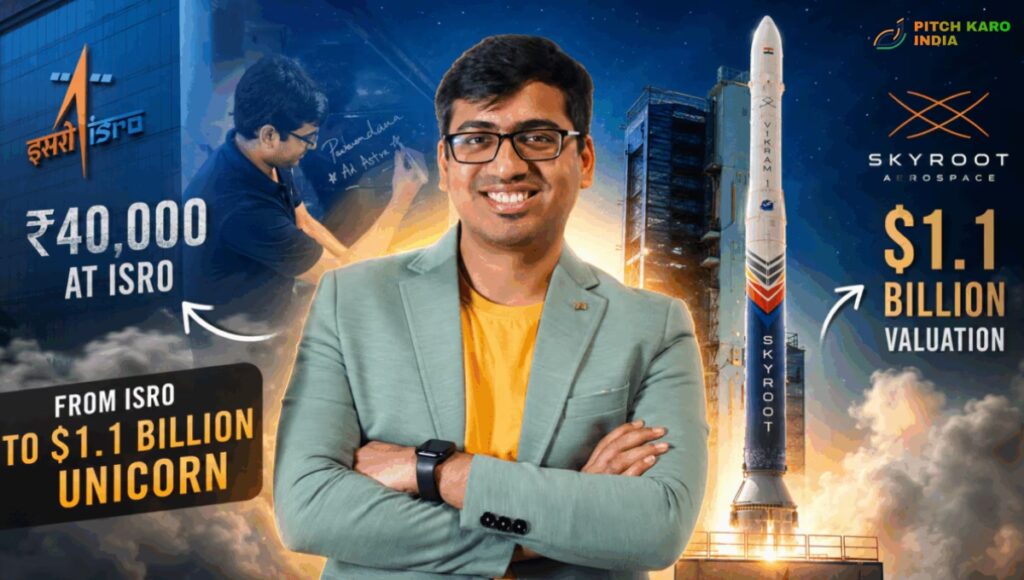
Skyroot Aerospace Founders: From ISRO To Space Success
Skyroot Aerospace: When people dream of space, they often imagine astronauts, rockets, and distant planets. Very few think about the people who spend years designing the technology that makes those dreams possible. In India, two engineers dared to believe that private companies could play a major role in the country’s space future. Their dream became Skyroot Aerospace, a startup that changed the history of India’s private space industry. Founded by former ISRO scientists Pawan Kumar Chandana and Naga Bharath Daka, Skyroot has grown from a bold idea into one of India’s most celebrated space technology companies.
The journey of Skyroot Aerospace is much more than the story of a startup. It is the story of courage, innovation, persistence, and the willingness to leave secure careers to build something extraordinary. From working on India’s prestigious space missions at ISRO to launching India’s first privately developed rocket, the founders have shown that determination and vision can create history.
The Beginning of Skyroot Aerospace
Skyroot Aerospace was founded in 2018 in Hyderabad, Telangana. At a time when India’s space industry was largely dominated by the Indian Space Research Organisation (ISRO), the founders believed the country was ready for a new era where private companies could contribute to satellite launches and space technology.
The company’s mission was simple yet ambitious. They wanted to make space accessible, affordable, and available on demand. Instead of waiting months or even years for launch opportunities, they envisioned a future where businesses, universities, governments, and researchers could launch satellites quickly and efficiently.
The name “Skyroot” itself reflects the company’s philosophy. Just as the roots of a tree provide strength and growth, Skyroot wanted to become the foundation for India’s future in commercial space exploration.
Meet the Visionary Behind Skyroot: Pawan Kumar Chandana
Pawan Kumar Chandana serves as the Chief Executive Officer (CEO) and Chief Technology Officer (CTO) of Skyroot Aerospace. His journey is a perfect example of how passion, education, and determination can transform an ordinary engineer into one of India’s leading space entrepreneurs.
Born with a fascination for science and engineering, Pawan pursued his higher education at the prestigious Indian Institute of Technology (IIT) Kharagpur. During his academic years, he developed a deep interest in aerospace engineering and rocket science.
After graduating, he joined ISRO, where he worked on several important launch vehicle projects. At ISRO, he gained valuable experience in rocket propulsion, launch systems, and mission planning. Working alongside some of India’s finest scientists gave him practical knowledge that would later become the backbone of Skyroot Aerospace.
Although ISRO provided an excellent career, Pawan believed India needed more innovation from the private sector. Inspired by the success of global private space companies, he envisioned an Indian startup capable of building world-class launch vehicles.
Leaving the comfort of a government job was not an easy decision. However, his desire to create something revolutionary outweighed the security of his career. That decision eventually led to the birth of Skyroot Aerospace.
Naga Bharath Daka: The Engineering Genius Behind Operations
Every successful startup needs a strong operational leader, and Skyroot found one in Naga Bharath Daka. An alumnus of IIT Madras, Bharath specialised in engineering and developed strong expertise in avionics and flight control systems. Before becoming an entrepreneur, he worked at ISRO as a flight computer engineer.
His responsibilities included developing avionics modules for Indian launch vehicles. These advanced systems act as the brain of a rocket, controlling navigation, communication, stability, and overall mission performance. His experience gave him deep insights into spacecraft electronics, launch operations, and mission reliability.
As the Chief Operating Officer (COO) of Skyroot Aerospace, Bharath oversees engineering operations, manufacturing processes, testing facilities, and mission execution. His technical leadership has played a crucial role in transforming innovative concepts into working rockets.
Two Friends with One Big Dream
Pawan Kumar Chandana and Naga Bharath Daka shared more than technical expertise. They shared a common belief that India’s private space industry had enormous untapped potential.
While working together at ISRO, they often discussed the future of commercial space technology. They observed how private companies in countries like the United States were revolutionising space transportation.
Instead of simply discussing possibilities, they decided to act. In 2018, they resigned from ISRO and established Skyroot Aerospace in Hyderabad. Like many startup founders, they started with limited resources but unlimited determination.
Building a space company is one of the most difficult entrepreneurial challenges in the world. Rockets require advanced engineering, expensive testing, strict safety standards, and years of research. Despite these challenges, the founders remained committed to their vision.
Early Challenges and the Road to Success
The early years of Skyroot were filled with obstacles. Finding investors for a space startup was difficult because rocket development involves high costs and long development cycles. Convincing people to invest in a young Indian aerospace company required exceptional confidence and technical credibility.
The founders also had to recruit talented engineers who believed in their mission. Building rocket engines, manufacturing facilities, testing infrastructure, and research laboratories required significant financial investment.
There were also regulatory challenges because India’s private space ecosystem was still evolving. Instead of giving up, the founders worked tirelessly to overcome every obstacle. Their ISRO experience helped them design reliable systems, while their entrepreneurial mindset enabled them to innovate rapidly.
Building India’s Private Rocket Ecosystem
Skyroot Aerospace focused on creating small satellite launch vehicles designed for the rapidly growing global satellite market. The company introduced the Vikram series of rockets, named in honour of Dr Vikram Sarabhai, the father of the Indian space program.
View this post on Instagram
Unlike traditional heavy rockets, Skyroot’s launch vehicles are designed for flexibility, lower costs, and faster deployment. The company also invested heavily in advanced manufacturing technologies, including carbon composite structures and 3D-printed rocket engines. These innovations reduced manufacturing time while improving rocket performance.
Breakthrough Technologies Developed by Skyroot
One of Skyroot’s greatest strengths is its commitment to innovation. The company developed India’s first fully 3D-printed cryogenic engine components. It introduced carbon composite rocket structures that are lighter and stronger than conventional materials. Skyroot also created modular rocket designs, allowing different payload capacities depending on customer requirements. The company’s engineering philosophy focuses on reducing launch costs without compromising safety or reliability.
Historic Achievement: Vikram-S Launch
On November 18, 2022, Skyroot Aerospace achieved a milestone that changed Indian space history. The company successfully launched Vikram-S, becoming the first private Indian company to launch a rocket into space. The mission, named Prarambh, demonstrated the capability of India’s private sector to design, build, and launch space vehicles.
The successful flight proved that private Indian companies could contribute significantly to the country’s space ambitions. The achievement received recognition from industry leaders, policymakers, scientists, and international observers.
The Vision Behind Vikram-1
- After the success of Vikram-S, Skyroot accelerated the development of Vikram-1, its orbital launch vehicle.
- Unlike the suborbital Vikram-S, Vikram-1 is designed to place satellites into orbit around Earth.
- This represents a major step toward providing commercial satellite launch services for customers worldwide.
- The company’s long-term vision includes launching multiple satellites efficiently while offering flexible launch schedules.
Raising Investments and Global Recognition
As Skyroot demonstrated its technological capabilities, investor confidence increased significantly. The company raised funding from prominent venture capital firms, institutional investors, and strategic partners.
This investment enabled Skyroot to expand research facilities, hire top engineering talent, and accelerate product development. International space organisations also began recognising Skyroot as one of Asia’s most promising commercial space companies.
Making Space Affordable
Traditional satellite launches often involve long waiting periods and high costs. Skyroot aims to change this model by offering affordable, responsive, and dedicated launch services.
This approach benefits startups, universities, research institutions, defence organisations, and commercial satellite operators. Affordable launches encourage innovation across industries that rely on satellite technology.
Leadership Style of the Founders
One of the reasons behind Skyroot’s rapid growth is the leadership philosophy of its founders. Pawan Kumar Chandana emphasises innovation, continuous learning, and ambitious thinking.
Naga Bharath Daka focuses on operational excellence, engineering quality, and disciplined execution. Together, they have created a company culture that encourages experimentation while maintaining the highest technical standards.
Impact on India’s Startup Ecosystem
Skyroot Aerospace has inspired an entirely new generation of Indian entrepreneurs. Its success demonstrates that Indian startups can compete globally even in highly advanced sectors like aerospace.
The company’s achievements have encouraged increased investment in deep-tech startups and space technology ventures. Young engineers across India now see entrepreneurship as a viable path alongside traditional government careers.
Why Skyroot Matters for India’s Future
The space economy is expected to grow rapidly over the coming decades. Communication satellites, Earth observation, navigation systems, climate monitoring, scientific research, and national security all depend on reliable access to space.
By building indigenous launch capabilities, Skyroot strengthens India’s position in the global commercial space market. The company also contributes to job creation, technological innovation, manufacturing excellence, and international competitiveness.
Lessons Entrepreneurs Can Learn from the Founders
- The story of Pawan Kumar Chandana and Naga Bharath Daka teaches several valuable lessons.
- Their journey proves that leaving a secure job can lead to extraordinary opportunities when backed by preparation and conviction.
- It also highlights the importance of combining technical expertise with business vision.
- Most importantly, their success shows that solving real-world problems creates lasting businesses.
- Rather than chasing trends, they focused on building technology that the global market genuinely needed.
The Road Ahead
Skyroot Aerospace continues to expand its capabilities with advanced launch vehicles, reusable technologies, improved propulsion systems, and next-generation satellite launch services. The company aims to become a leading global provider of affordable launch solutions while contributing to India’s ambition of becoming a major space power.
With continuous innovation and a growing international customer base, Skyroot appears well positioned to play a defining role in the future of commercial space exploration.
The journey that began with two former ISRO engineers and a bold dream has already transformed India’s private space industry. As Skyroot Aerospace moves forward, it stands as a symbol of what vision, courage, and relentless determination can achieve. From humble beginnings to rewriting history, the story of Pawan Kumar Chandana and Naga Bharath Daka reminds us that extraordinary success often begins with a simple belief that the impossible can become possible.
Conclusion
Skyroot Aerospace is more than just a successful startup. It represents a new chapter in India’s technological evolution. Founded by Pawan Kumar Chandana and Naga Bharath Daka in 2018, the company has demonstrated that private innovation can complement national achievements in space exploration. Their transition from ISRO scientists to entrepreneurs required immense courage, technical brilliance, and unwavering determination.
Today, Skyroot Aerospace stands as a beacon of innovation, inspiring thousands of engineers, students, and aspiring entrepreneurs. Their “zero to hero” journey proves that with knowledge, perseverance, and a clear vision, even the most ambitious dreams can become reality. As India continues its rise as a global space powerhouse, the story of Skyroot Aerospace will remain one of the country’s most inspiring entrepreneurial success stories.