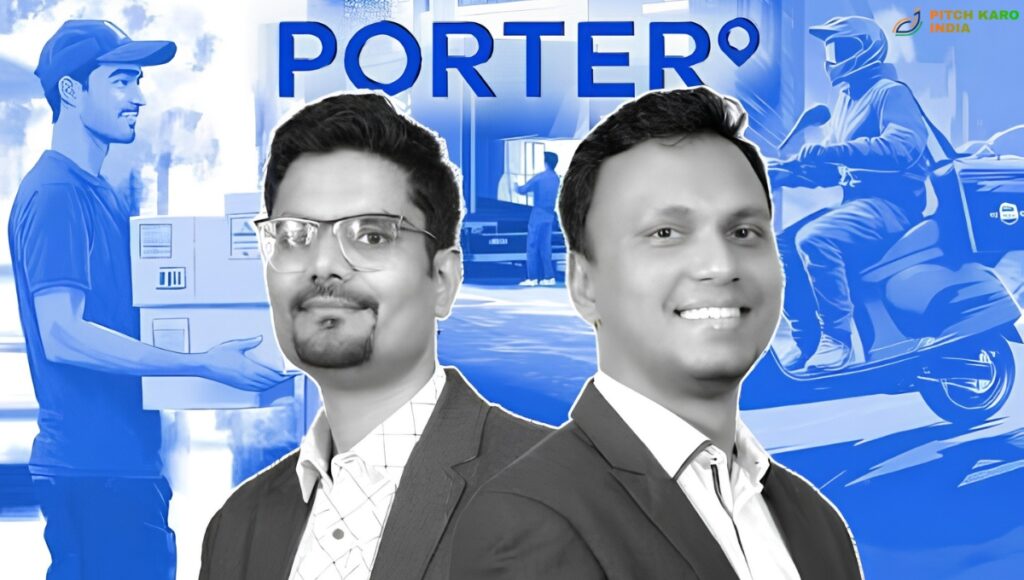
Who Are the Founders of Porter? The Inspiring Story of Pranav Goel, Uttam Digga and Vikas Choudhary
Porter: Sometimes, the biggest business ideas come from the simplest problems we face in everyday life. Moving a sofa across the city, sending products from a shop to a customer, transporting goods to another location, or simply finding a reliable vehicle at the right time may sound like ordinary tasks. But for businesses and families, these small needs can become surprisingly difficult when the right transport is not available.
This everyday problem became the foundation for Porter, a technology-driven logistics company that has changed the way many people think about intra-city transportation. Founded in 2014, Porter was started by three IIT Kharagpur alumni, Pranav Goel, Uttam Digga, and Vikas Choudhary. Each founder brought a different strength to the table, and together they worked on creating a platform that could connect customers with vehicles and driver partners through technology.
The story of Porter is interesting not only because of the company it eventually became, but also because of the people behind it. Pranav Goel focused heavily on business leadership, Uttam Digga played an important role in operations and driver onboarding, while Vikas Choudhary worked on the early technology platform and app interface.
Their journey is a good example of how three people with different responsibilities can come together around one common problem and build a business around solving it.
The Beginning of Porter in 2014
Porter was founded in 2014 at a time when smartphones, mobile applications, and internet-based services were beginning to change everyday life in India. The startup ecosystem was also becoming more exciting, with young entrepreneurs looking for ways to use technology to solve problems in traditional industries. Transportation was one such industry.
For years, people who needed a small commercial vehicle often had to depend on local contacts, individual drivers, brokers, or transport operators. Finding a suitable vehicle was not always quick or convenient. Customers could also face uncertainty around availability, pricing, timing, and communication.
The founders of Porter saw an opportunity in this gap. Instead of treating transportation as a completely traditional business, they looked at how technology could make the process more convenient and organised. The idea was to create a platform where customers could access transportation services more easily while drivers could find opportunities through a digital system.
It was a simple idea at its core, but implementing it in the real world required much more than building an application. It required technology, operations, customer understanding, and a strong network of drivers. That is where the different strengths of Porter’s three founders became important.
Who Are the Three Founders of Porter?
Porter was founded by Pranav Goel, Uttam Digga, and Vikas Choudhary. All three are alumni of IIT Kharagpur, one of India’s most respected technical institutions.
Their educational background gave them a strong foundation in analytical thinking and problem-solving. However, building Porter required them to apply those skills to a completely practical challenge involving transportation, customers, drivers, technology, and business operations.
The three founders did not simply perform identical roles. Instead, they contributed in different areas that complemented one another.
Pranav Goel became one of the central figures in the company’s business and leadership journey. He served as CEO for a long period and later took on the role of Executive Vice Chairman.
Uttam Digga focused strongly on the operational side of the company. His responsibilities included managing operations and working on driver onboarding, both of which are extremely important for a logistics platform.
Vikas Choudhary brought a technology-focused perspective to the founding team. He worked on building the initial technology platform and app interface that would help turn the business idea into a usable digital service. Together, their roles created a combination of business leadership, operational execution, and technology development.
Pranav Goel and His Role at Porter
Pranav Goel is one of the co-founders of Porter and has played a major role in the company’s journey. He served as the company’s CEO for many years before moving into the role of Executive Vice Chairman.
Being the founder of a startup is very different from simply having a business idea. The founder has to make difficult decisions, understand the market, build a team, deal with uncertainty, and constantly figure out how the business can grow while staying useful to its customers. Pranav Goel’s role in Porter was closely connected with this larger leadership responsibility.
From the early stages of the company, Porter had to deal with a market that involved traditional transportation practices. Bringing customers, vehicles, and drivers onto a technology platform required a clear business direction and a willingness to keep adapting.
A logistics startup also cannot depend only on technology. It needs a business model that works in the real world. A customer may book a vehicle through an application, but the actual service still depends on a driver arriving at the right location, carrying the goods, and completing the trip successfully.
This combination of digital technology and physical operations makes logistics a particularly challenging sector. As a long-time leader of Porter, Pranav Goel was involved in navigating these challenges and helping shape the company’s broader direction.
His journey also reflects an important part of modern entrepreneurship. Founders often have to evolve with their companies. The responsibilities involved in starting a small business can be very different from those required to lead a growing organisation.
Uttam Digga: The Operations-Focused Co-Founder
Uttam Digga is another co-founder of Porter and has been closely associated with the company’s operations. He also became the company’s CEO and had previously worked on areas such as operations and driver onboarding. For a logistics company, operations are not just another department. They are at the heart of the customer experience. Imagine booking a vehicle to move goods from one part of a city to another. The customer expects the vehicle to be available when required. The driver needs to receive the correct information. The pickup location has to be understood properly. The goods need to reach their destination safely, and communication has to remain smooth throughout the journey. If even one part of this chain fails, the customer experience can suffer. This is why driver onboarding and operational management are so important for a company like Porter.
View this post on Instagram
Uttam Digga’s involvement in these areas helped address the practical side of the business. While a technology platform could connect people digitally, the actual service still depended on people working on the ground. Building a reliable driver network is also a significant challenge. Drivers need to understand the platform, customers need confidence in the service, and the company needs systems that allow both sides to interact efficiently. This operational foundation became an important part of Porter’s business approach.
Vikas Choudhary and the Technology Behind the Idea
Vikas Choudhary joined the founding team with an important technology-focused responsibility. He worked on developing the initial technology platform and app interface for Porter.
This part of the story is particularly interesting because the technology was not being developed simply to create another mobile application. It was being created to solve a physical, real-world problem.
A transportation platform needs technology that can support multiple activities at the same time. Customers need a way to request services. Drivers need access to relevant information. The company needs to coordinate the two sides, while the entire system needs to function smoothly enough to handle real-world transportation requirements. The early technology platform therefore became an important bridge between customers and the transportation network.
Today, booking services through mobile applications has become a normal part of everyday life. People use apps for food delivery, taxis, shopping, payments, travel, and many other services. But when Porter was getting started, applying this approach to local goods transportation was an interesting challenge.
Vikas Choudhary’s contribution was therefore closely connected with transforming the business idea into a digital product that people could actually use.
How Porter’s Business Idea Works
At its basic level, Porter’s business model is connected to the transportation of goods within cities. The platform aims to make it easier for customers and businesses to access vehicles for moving goods.
Think about a small shop that needs to send products to another location. In a traditional setup, the shopkeeper might have to call several drivers or rely on a local transport contact. There could be uncertainty about whether a vehicle is available and how quickly it can arrive.
A technology-enabled platform can make this process more organised. The customer can request transportation through the platform, while driver partners can receive opportunities through the same ecosystem. This creates a connection between demand and supply.
The idea becomes particularly useful for small and medium-sized businesses because transportation is often an essential part of their daily operations.
For households, too, local transportation can become necessary when moving furniture, appliances, boxes, or other larger items. Porter’s model is therefore based on addressing a common need rather than creating an entirely new need.
Why Logistics Was a Smart Opportunity
India has a huge and diverse transportation market. Goods move constantly between shops, warehouses, homes, offices, markets, and businesses.
Yet the process of arranging smaller transportation requirements has historically been fragmented. Local drivers and transport operators may know their areas well, but customers do not always have a simple way to find the right vehicle at the right time. This fragmentation created an opportunity for technology.
Porter’s founders recognised that a digital platform could potentially bring greater convenience to this process. Instead of relying entirely on informal networks, customers could use technology to access transportation services.
This idea also created an opportunity for drivers. A platform could potentially help them connect with more customers and find work through a centralised system.
The value of such a model comes from connecting both sides effectively. The customer wants a reliable transportation service. The driver wants relevant work. The platform attempts to bring the two together.
The Importance of the Three Founders Working Together
One of the most interesting aspects of Porter’s founding story is the combination of different skills within the founding team. A startup does not necessarily need three people who know the same things. In many cases, it can be more effective when the founders have complementary strengths. Porter’s founding structure reflects this idea.
Pranav Goel brought business leadership and strategic direction. Uttam Digga focused on operations and driver-related processes. Vikas Choudhary concentrated on technology and the initial app experience. These areas are deeply connected.
Technology without operations would not be enough. Operations without customers would not create a sustainable business. And a good business idea without technology and execution would struggle to scale.
The founders therefore had to work on different pieces of the same puzzle. This is one of the biggest lessons young entrepreneurs can take from Porter’s story. Building a company is rarely about doing everything yourself. It is about finding the right people, dividing responsibilities intelligently, and making sure everyone is working toward the same goal.
The IIT Kharagpur Connection
All three Porter founders are alumni of IIT Kharagpur. This shared educational background is an important part of their story.
IIT Kharagpur has produced entrepreneurs, engineers, researchers, and business leaders across different industries. Its strong focus on technical education and problem-solving provides students with an environment where they are encouraged to think deeply about complex challenges.
For the Porter founders, that analytical mindset was eventually applied to the transportation sector. However, education alone does not create a successful company.
A technical degree can provide knowledge and problem-solving skills, but entrepreneurship requires a different kind of learning. Founders have to understand customers, employees, competition, finances, marketing, operations, and countless unexpected problems. Porter’s journey demonstrates how technical education can become the starting point for solving practical business problems.
What Makes Porter’s Founding Story Inspiring?
The most inspiring part of Porter’s story is perhaps the fact that the company was built around a problem that many people could easily overlook.
Transportation may not sound as glamorous as artificial intelligence, social media, or financial technology. But it is a fundamental part of everyday economic activity.
Every shop that receives inventory, every business that moves products, and every household that needs to transport large items depends on some form of logistics. The founders recognised that there was room to make this experience easier through technology.
Their story shows that a successful startup idea does not always have to be completely futuristic. Sometimes, the strongest opportunity is hidden inside an old industry that has not yet been organised or improved through modern technology.
What Young Entrepreneurs Can Learn From Porter
Porter’s journey offers several valuable lessons for anyone thinking about starting a business. The first lesson is to pay attention to everyday problems. People often search for complicated startup ideas when there are already countless problems around them waiting for better solutions.
The second lesson is that technology becomes powerful when it solves a real problem. An app by itself does not create value. The value comes from what the app allows people to do more easily.
The third lesson is the importance of execution. A business idea can look brilliant on paper, but real customers, drivers, locations, timings, payments, and operational challenges can make implementation much harder.
The fourth lesson is the importance of having a strong founding team. Pranav Goel, Uttam Digga, and Vikas Choudhary brought different skills to Porter. Their ability to work on business leadership, operations, and technology gave the company a broader foundation.
Perhaps the biggest lesson is that building a company takes patience. A startup is not created overnight. It takes time to understand the market, improve the product, build trust, and develop systems that can handle growth.
The Legacy of Porter’s Founders
Since its founding in 2014, Porter has become a recognisable name in India’s logistics and transportation ecosystem. The company’s story began with three IIT Kharagpur alumni who saw an opportunity to use technology in an industry that had traditionally depended heavily on local networks and manual processes.
Pranav Goel, Uttam Digga, and Vikas Choudhary each contributed to a different part of that journey.
Pranav Goel’s leadership helped shape the company’s business direction. Uttam Digga’s involvement in operations and driver onboarding addressed the ground-level realities of the service. Vikas Choudhary’s technology work helped turn the original concept into a digital platform.
Together, these contributions created the foundation for Porter. Their story also represents a broader change happening in India. Technology is increasingly entering traditional industries and changing the way people access everyday services. Logistics is one of the sectors where this transformation can have a direct impact on businesses and consumers.
Final Thoughts
The story of Porter is ultimately a story about recognising a problem and having the courage to build a solution around it. Pranav Goel, Uttam Digga, and Vikas Choudhary started Porter in 2014 with a vision of bringing technology into the local transportation and logistics space. All three came from IIT Kharagpur, but their success was not simply about where they studied. Their real contribution came from how they used their different skills to tackle a practical problem.
Pranav Goel became a key business leader and served as CEO for many years before taking on the role of Executive Vice Chairman. Uttam Digga worked closely with operations and driver onboarding and later became CEO. Vikas Choudhary focused on the early technology platform and app interface.
Their different responsibilities show why a balanced founding team can be so valuable. Porter’s journey also reminds us that great businesses can emerge from ordinary problems. Finding a vehicle, moving goods, helping a shop deliver products, or shifting household items may sound simple, but millions of people need these services every day.
When technology is used thoughtfully to make such everyday experiences easier, it can create something much bigger than an app. It can create an entire ecosystem.
That is what makes the story of Porter’s founders worth knowing. It is not simply the story of three IIT graduates starting a company. It is the story of three people looking at a familiar problem from a different angle and attempting to build a more convenient way of solving it.