Who Is the Founder of Swiggy? The Inspiring Story of Sriharsha Majety, Nandan Reddy and Rahul Jaimini
Some businesses become part of our daily lives so quietly that we almost forget how difficult the problem was before they existed. Ordering food from a favourite restaurant, checking the menu on a phone, paying online and watching the delivery move toward your doorstep now feels completely normal. But behind that simple experience is a long story of ideas, risks, technology and people who believed that everyday life could be made easier.
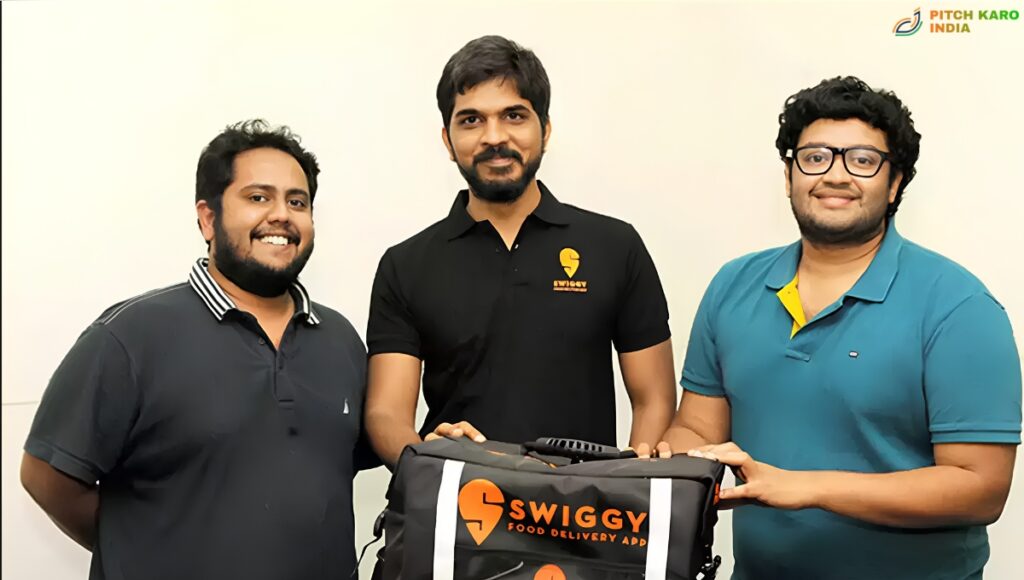
One of the biggest names behind this transformation in India is Swiggy. The company was founded in 2014 by Sriharsha Majety, Nandan Reddy and Rahul Jaimini. What began as an attempt to solve problems around food ordering and delivery eventually grew into a much broader consumer convenience platform.
Today, Swiggy describes itself as a consumer-first, on-demand convenience platform. Its ecosystem has expanded beyond food delivery into areas such as quick commerce, dining out and other consumer services. The company’s official profile says it was founded in 2014, while its corporate history records the launch of its food delivery business in the same year.
But before Swiggy became a familiar name on millions of smartphones, three people were trying to understand a simple question: how could technology make ordering and receiving food more convenient? Those three people were Sriharsha Majety, Nandan Reddy and Rahul Jaimini.
How the Swiggy Story Started
The early story of Swiggy is closely connected with the changing habits of Indian consumers. Smartphones and internet access were becoming increasingly common, and people were becoming more comfortable using digital platforms for everyday needs. Food was an obvious area where technology could make a difference.
Restaurants already had customers, and delivery already existed in many forms. The challenge was bringing the experience together in a way that was easier to discover, order, pay for and track. This is where the founders saw an opportunity.
Instead of simply creating another restaurant directory, the idea was to build a technology-led service that could connect customers, restaurants and delivery partners. Over time, this model became much more sophisticated, but the basic promise remained simple: make life more convenient for the urban consumer.
Swiggy’s current mission reflects that same philosophy. The company says its goal is to elevate the quality of life of urban consumers by offering convenience. That focus on convenience has played an important role in shaping the company from its early days.
Who Are the Founders of Swiggy?
Swiggy was co-founded by Sriharsha Majety, Nandan Reddy and Rahul Jaimini in 2014. The three founders brought different experiences and abilities to the company. Sriharsha Majety became the most prominent public face of the company and has continued to lead Swiggy for many years. Nandan Reddy became closely associated with innovation and new business initiatives, while Rahul Jaimini contributed to the technology side of the early business.
The combination was important because building a food delivery company involves far more than creating an application. There needs to be a strong customer experience, reliable restaurant relationships, an efficient delivery network, technology capable of handling large numbers of orders and a business model that can work in a highly competitive market.
The founders therefore had to think about the problem from several different angles. Swiggy’s corporate filings also officially identify Sriharsha Majety, Lakshmi Nandan Reddy Obul and Rahul Jaimini as the company’s founders.
Sriharsha Majety: The Face of Swiggy’s Leadership
Among Swiggy’s three founders, Sriharsha Majety has remained the most closely associated with the company’s leadership. He is currently Swiggy’s Managing Director and Group CEO, as listed on the company’s corporate governance page. Swiggy’s official profile identifies him as its Group CEO and Co-Founder.
Majety’s educational and professional background also reflects a strong combination of technology, management and business thinking. According to Swiggy, he holds a bachelor’s degree in Electrical and Electronics Engineering from BITS Pilani and an MBA from IIM Calcutta. Before becoming an entrepreneur, he started his career in investment banking with Nomura International in the United Kingdom.
That background became useful when he entered the world of startups. Starting a company is very different from working in an established organisation. There is no guaranteed path, no fixed playbook and often very little certainty about what will happen next.
For Majety, the challenge was to build a company in an emerging market while understanding what Indian consumers actually wanted.
Food delivery looks simple from the outside, but the reality is much more complicated. A customer places an order, but that order must travel through a chain involving the restaurant, technology platform and delivery partner.
The restaurant has to receive the order and prepare it. The delivery partner needs to reach the right location, collect the food and deliver it within an acceptable time. The customer expects the process to be smooth. Every part of that chain has to work.
Leading a business built around such a complicated system requires patience, adaptability and a willingness to keep improving the model. Sriharsha Majety’s long association with Swiggy reflects that journey.
Nandan Reddy and His Contribution to Swiggy
Nandan Reddy is another important name in Swiggy’s founding story. His full name is Lakshmi Nandan Reddy Obul, and Swiggy’s corporate records identify him as one of the company’s founders.
Over the years, Reddy has been associated with innovation and new initiatives at Swiggy. The company’s current corporate profile lists him as a Whole-time Director and Head of Innovation. Innovation is particularly important for a company operating in a rapidly changing consumer market.
Customer expectations do not remain the same forever. What people wanted from food delivery several years ago is different from what they expect today. Faster delivery, better selection, convenience, digital payments, dining offers, grocery delivery and other services have gradually become part of the broader digital consumption experience. This is where an innovation-focused approach can become valuable.
Swiggy has repeatedly expanded into new categories rather than remaining limited to restaurant food delivery. Its official history records the launch of Swiggy Instamart and Swiggy Genie in 2020, Swiggy One in 2021, Dineout integration in 2022 and additional launches in subsequent years.
The company’s evolution shows how a startup can gradually transform its original idea. What began around food delivery eventually became a broader attempt to build an on-demand convenience ecosystem.
Rahul Jaimini and the Technology Foundation
Rahul Jaimini is the third co-founder of Swiggy. While consumers often see only the colourful application on their smartphones, the technology behind a platform like Swiggy is enormously complex. It needs to connect customers with restaurants and delivery partners while handling orders, payments, locations, availability and communication.
Technology was therefore not simply an optional feature of the business. It was at the heart of the model. Jaimini’s contribution to the founding team was connected with the technology side of the company and helped establish the digital foundation required for the platform.
Building technology for a delivery business presents a very different challenge from building a simple website or application. The system has to respond to real-world events happening continuously.
A restaurant may suddenly become busy. A delivery partner may be delayed. A customer may change an address. Traffic conditions can affect delivery time. An item may become unavailable. Thousands of orders can be moving at the same time.
All these variables have to be managed through technology. That is why the technology foundation created during the company’s early years became such an important part of Swiggy’s development.
Why Food Delivery Was Such a Difficult Business
One might look at food delivery today and wonder why it was ever difficult. After all, customers simply select food and place an order. But the real challenge is behind the screen.
Swiggy has to coordinate several groups at the same time. Customers want convenience and reliability. Restaurants want more orders and efficient operations. Delivery partners want earning opportunities and practical working conditions. The platform has to create value for all three.
If customers do not have enough restaurant choices, they may stop using the service. If restaurants do not find the platform useful, they may reduce their participation. If the delivery network is not efficient, customers may experience delays. This creates a delicate balance.
Swiggy’s current food delivery business allows users to discover restaurants, browse menus, place orders, make payments and track deliveries. Orders are prepared by restaurant partners and delivered through the platform’s delivery partner network. The simplicity customers see is therefore supported by a much larger operational and technological system.
From Food Delivery to a Larger Convenience Platform
Perhaps the most interesting part of Swiggy’s journey is that the company did not stop at food delivery. As consumer habits changed, Swiggy started exploring additional services that could fit into the same broader idea of convenience.
One of the biggest examples is Swiggy Instamart, its quick commerce business. The service allows consumers to order groceries and other household products through the platform. Swiggy says Instamart orders are processed through merchant partners and dark stores before being delivered through delivery partners.
Swiggy also expanded into restaurant discovery and dining through Dineout. The service allows users to discover restaurants, view menus, make reservations, access offers and make digital payments.
This expansion tells an important story about the founders’ original vision. The company was not necessarily interested in being only a food ordering application. The larger opportunity was convenience.
If consumers already trust a platform for food, that platform may have an opportunity to help with other everyday needs as well. This thinking has helped Swiggy move from a single-category business toward a broader consumer platform.
What Makes the Swiggy Founders’ Story Interesting?
The founders’ journey is interesting because it shows how an idea can change as the company grows. Sriharsha Majety, Nandan Reddy and Rahul Jaimini did not simply create a service and leave it unchanged. The business had to respond to consumer behaviour, competition, technology and changing market conditions. That is one of the hardest parts of entrepreneurship. A founder may begin with a very specific problem in mind, but as customers start using the product, new opportunities and new challenges appear.
View this post on Instagram
Sometimes the original idea becomes bigger. Swiggy is an example of that transformation. The company started its food delivery business in 2014 and later entered quick commerce, dining and other areas of consumer convenience. The journey demonstrates that successful businesses often evolve instead of following one fixed plan forever.
The Importance of Technology in Swiggy’s Growth
Technology is one of the strongest pillars of Swiggy’s business. Without technology, it would be extremely difficult to coordinate such a large ecosystem of consumers, restaurants, merchants and delivery partners.
The platform needs to make discovery easy for customers while helping restaurants manage orders and enabling delivery partners to complete trips.
Over time, the technology layer has also become important for personalisation, logistics, payments, customer support and operational efficiency. Swiggy describes its platform as being supported by a technology backbone and a unified app experience. The company also uses Swiggy One as a membership program across multiple services. This illustrates how the original food delivery application gradually developed into a larger technology ecosystem.
The Bigger Lesson Behind Swiggy’s Journey
There is a valuable lesson hidden inside the Swiggy story for young entrepreneurs. A great startup does not always begin with an enormous idea. Sometimes it starts by asking a very ordinary question.
Can this process be made easier? Can customers save time? Can technology remove unnecessary friction?
Can different people in a fragmented market be connected more efficiently? These questions can lead to surprisingly large businesses.
Swiggy’s founders entered an industry where food delivery already existed in different forms. They did not invent the concept of restaurants delivering food. Instead, they worked on building a technology-led system that could make discovery, ordering, payment and delivery more convenient. That distinction is important.
Innovation does not always mean inventing something that has never existed. Sometimes it means taking an existing process and rebuilding it around the needs of modern consumers.
Swiggy’s Journey After Becoming a Public Company
Another major milestone came in 2024, when Swiggy became a publicly listed company. Swiggy’s corporate website identifies its public listing as one of the key events in its journey. Going public represents a major change for a company.
A startup backed primarily by private investors operates differently from a publicly listed company. Once listed, the business faces greater public scrutiny and has to communicate more formally with shareholders and the wider market. For the founders, this represents another stage in the journey that began in 2014.
The company that started as a young startup has grown into a large consumer platform with multiple business lines. Sriharsha Majety continues to serve as Managing Director and Group CEO, while Nandan Reddy remains part of the company’s leadership as Whole-time Director and Head of Innovation.
What Young Entrepreneurs Can Learn From the Founders
The first lesson is that solving a real problem matters more than chasing a fashionable idea. Food delivery was not simply a technology trend. It addressed a genuine consumer need for convenience.
The second lesson is that founders need to understand the entire ecosystem around a problem. Swiggy’s business is not only about customers. Restaurants, merchants, delivery partners and technology all play important roles. The third lesson is adaptability.
A company that refuses to change can quickly become outdated. Swiggy’s expansion into Instamart, Dineout and other services shows how a company can continue exploring new opportunities around its central idea of convenience. The fourth lesson is patience.
Building a large company takes years. There are periods of excitement, difficult decisions, intense competition and uncertainty. The founders’ continued involvement over many years shows how entrepreneurship is often a long journey rather than a quick success story.
Final Thoughts
The story of Swiggy’s founders is much more than a simple answer to the question, “Who founded Swiggy?” The company was co-founded in 2014 by Sriharsha Majety, Nandan Reddy and Rahul Jaimini, three people who came together to build a technology-driven approach to food delivery.
Sriharsha Majety became the company’s central business leader and currently serves as Managing Director and Group CEO. Nandan Reddy has been associated with innovation and is currently listed as Whole-time Director and Head of Innovation. Rahul Jaimini was one of the original co-founders and contributed to the company’s early technology foundation. What makes their journey special is the way the original idea evolved.
Swiggy started its food delivery business in 2014. Over the years, it expanded into quick commerce, dining and other convenience-focused services. Today, the company describes itself as a broader on-demand convenience platform rather than simply a food delivery service. At the heart of the story is a very human idea: people want life to be a little easier.
They want their favourite meal without spending time travelling. They want groceries when they need them. They want to discover restaurants, make reservations and handle everyday tasks without unnecessary complications. The founders of Swiggy recognised that technology could help bring many of these experiences together.
And perhaps that is the most important lesson from their journey. Great companies do not always begin by trying to change the entire world. Sometimes, they begin by making one ordinary part of everyday life a little easier. Over time, if that solution genuinely helps people and the team continues to adapt, a small idea can grow into something remarkably large.