
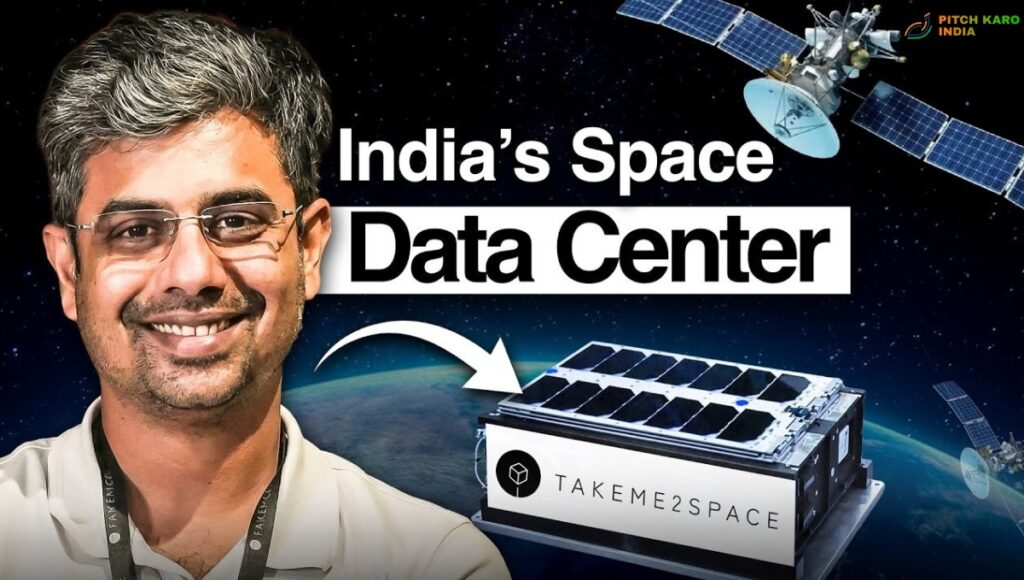
TakeMe2Space’s Mission To Build The AWS Of Space
TakeMe2Space: The global space industry is entering a new era. For decades, satellites have primarily been used for communication, navigation, weather forecasting, and Earth observation. However, the rapid growth of artificial intelligence, cloud computing, and data-intensive applications is creating an entirely new challenge.
Satellites today collect enormous volumes of information every second, but most of that data still needs to be transmitted back to Earth before it can be processed. This process consumes valuable bandwidth, increases operational costs, and often delays critical decision-making.
An ambitious Indian startup, TakeMe2Space, believes there is a better way. Instead of sending raw satellite data to Earth first, the Hyderabad-based spacetech company wants satellites to process information while they are still in orbit. Its vision is simple yet revolutionary: create a computing infrastructure in space that functions much like Amazon Web Services (AWS) transformed cloud computing on Earth.
If successful, this approach could fundamentally change how satellite data is handled, opening new possibilities for artificial intelligence, defence, climate monitoring, disaster response, and commercial space applications.
Although the journey is still in its early stages, TakeMe2Space has already attracted attention for its bold ambitions. The company is not merely building satellites; it is working towards establishing an entirely new layer of digital infrastructure beyond Earth’s atmosphere. As India’s rapidly growing spacetech ecosystem expands beyond rockets and launch vehicles, TakeMe2Space hopes to become one of the pioneers defining the future of orbital computing.
The Next Evolution of Space Technology
Space technology has traditionally focused on launching satellites capable of collecting information. Whether observing forests, oceans, cities, agricultural fields, or weather systems, these satellites generate massive amounts of data every day. However, collecting information is only the first step. The real value lies in analysing that information quickly and accurately.
Currently, most satellites transmit raw data back to ground stations, where powerful computers process it before sending results to users. While this system has worked for years, it comes with several limitations. Large data transfers consume communication bandwidth, increase latency, and often create delays that are unacceptable for time-sensitive applications such as emergency response, military surveillance, or disaster management.
TakeMe2Space believes the future lies in processing information directly inside satellites. Instead of treating satellites merely as data collectors, the company wants them to become intelligent computing platforms capable of analysing information before transmitting only the final results to Earth.
Understanding Orbital Computing
Orbital computing may sound futuristic, but its basic idea is surprisingly straightforward. Imagine taking a data centre and placing its computing capabilities inside satellites orbiting the Earth. Rather than downloading every piece of information, satellites perform complex calculations while still in space.
This significantly reduces the amount of data that needs to be transmitted back to Earth. Instead of sending thousands of high-resolution images, for example, a satellite could analyse those images in orbit, identify areas affected by floods or forest fires, and transmit only the relevant findings.
Such an approach can dramatically improve efficiency while reducing communication costs. More importantly, it enables much faster decision-making when every second matters.
Why Space Needs Cloud Computing
The comparison between TakeMe2Space and Amazon Web Services is not accidental. AWS transformed software development by allowing businesses to rent computing resources whenever they needed them instead of purchasing expensive servers.
TakeMe2Space wants to apply a similar concept to space. Rather than requiring organisations to build powerful onboard computers for every satellite mission, the company envisions shared orbital computing infrastructure that multiple customers can access.
Researchers, commercial satellite operators, government agencies, defence organisations, environmental monitoring companies, and AI developers could potentially run applications directly in orbit using this shared infrastructure.
If this vision becomes reality, orbital computing could become as essential to future satellite operations as cloud computing has become for businesses on Earth.
Why Artificial Intelligence Is Driving This Vision
Artificial intelligence has dramatically increased the amount of computing power required across industries. Modern AI systems analyse enormous datasets, identify complex patterns, and generate valuable insights within seconds.
Satellites generate exactly the kind of large-scale data that AI thrives on. Earth observation satellites continuously monitor weather systems, agricultural activity, infrastructure development, marine traffic, glaciers, forests, and urban expansion.
Processing these datasets directly in orbit could allow AI models to detect changes almost instantly. Governments could identify floods before they worsen. Farmers could receive crop health assessments sooner. Environmental agencies could monitor deforestation more efficiently. Emergency responders could access critical information faster during natural disasters.
Building OrbitLab
At the centre of TakeMe2Space’s strategy is its OrbitLab platform. The company is working to create an ecosystem where customers can deploy software, process satellite information, and utilise orbital computing resources without building their own specialised infrastructure.
OrbitLab represents more than software. It aims to become a platform connecting satellites, onboard computing, AI workloads, and cloud-like services in space.
If successfully developed, OrbitLab could simplify how organisations interact with satellites by providing computing capabilities as a service instead of requiring expensive customised hardware.
A Vision Beyond Traditional Satellites
India’s space industry has traditionally focused on launch vehicles, satellite manufacturing, communication systems, and Earth observation missions. TakeMe2Space represents a different generation of spacetech startups that see space not merely as a destination but as a computing environment.
Instead of competing with launch providers, the company is building infrastructure that supports future satellite operations regardless of who launches them.
This shift mirrors the evolution of the internet itself. Building satellites is similar to constructing communication networks, while orbital computing resembles creating cloud platforms that unlock entirely new digital services.
Learning From Early Setbacks
Innovation rarely follows a straight path. TakeMe2Space experienced a significant setback when its first satellite was lost during a failed PSLV mission.
For many young startups, such an event could have delayed progress indefinitely. Satellite development requires years of engineering work, extensive testing, and significant financial investment. Losing a spacecraft before it reaches orbit represents both a technical and emotional challenge.
However, the company has chosen to continue pursuing its long-term vision rather than allowing one unsuccessful mission to define its future.
Preparing for the Next Launch
TakeMe2Space is now preparing for another major milestone. The startup plans to launch its next satellite aboard SpaceX’s Falcon 9 rocket in October. This upcoming mission carries enormous significance. Beyond demonstrating the company’s technology, it represents another opportunity to validate its orbital computing approach under real operating conditions.
View this post on Instagram
Every successful mission brings valuable engineering data, helping refine hardware, software, reliability, and long-term operational capabilities.
Building a Constellation Instead of One Satellite
One satellite alone cannot create global computing infrastructure. Recognising this, TakeMe2Space plans to build an entire constellation of compute-enabled satellites.
Constellations allow multiple spacecraft to work together, expanding coverage, increasing reliability, and providing continuous computing services across different regions of the world.
As more satellites join the network, the available computing capacity also increases, making the platform increasingly valuable for commercial customers.
The Challenges Ahead
Although the concept is exciting, building orbital computing infrastructure presents enormous challenges. Launching satellites remains expensive despite declining launch costs. Hardware must survive radiation, extreme temperatures, and years of operation in space. Every onboard computer must function reliably without the possibility of physical repairs.
Commercial adoption also remains uncertain. Customers must be convinced that processing information in orbit delivers measurable economic advantages compared with existing Earth-based computing systems.
Launch schedules present another challenge. Satellite deployments depend on available launch opportunities, regulatory approvals, and international partnerships.
Can Orbital Computing Become Commercially Viable?
Perhaps the biggest question surrounding TakeMe2Space is whether orbital computing can become a profitable business. History shows that many transformative technologies initially appeared economically uncertain. Cloud computing, electric vehicles, reusable rockets, and commercial satellite internet all faced scepticism before proving their value.
If orbital computing reduces operational costs, accelerates decision-making, and enables entirely new services, demand could grow rapidly over the coming decade. However, success will depend on demonstrating real customer value rather than technological capability alone.
India’s Expanding Spacetech Ecosystem
India’s private space sector has evolved dramatically since regulatory reforms opened new opportunities for startups. Today, Indian companies are working across satellite manufacturing, launch services, propulsion systems, communication technologies, Earth observation, robotics, and deep-space exploration.
TakeMe2Space represents this new wave of innovation where software, artificial intelligence, and digital infrastructure become as important as rockets themselves.
As more startups explore advanced technologies, India is gradually positioning itself as an important participant in the global commercial space economy.
Competition on the Global Stage
Orbital computing is attracting growing international interest. Around the world, companies are exploring edge computing, AI-enabled satellites, and autonomous onboard processing.
This means TakeMe2Space will eventually compete not only with Indian startups but also with established international aerospace companies and emerging global spacetech innovators. Its success will depend on technological excellence, strategic partnerships, reliable execution, and continuous innovation.
Why This Vision Matters
The importance of orbital computing extends beyond commercial profits. Climate monitoring, disaster management, defence intelligence, precision agriculture, scientific research, environmental protection, maritime surveillance, and space exploration all generate enormous amounts of satellite data.
Processing this information directly in orbit could significantly improve response times while reducing communication bottlenecks.
In an increasingly data-driven world, computing closer to where information is generated has become an important technological trend. TakeMe2Space is attempting to extend that philosophy beyond Earth itself.
The Road Ahead
TakeMe2Space still has many milestones ahead before its vision becomes reality. Successful launches, reliable satellite performance, customer adoption, regulatory support, and sustainable economics will all determine whether the company can achieve its ambitious goals. Yet every major technological revolution begins with organisations willing to challenge conventional thinking.
Whether or not TakeMe2Space ultimately becomes the “AWS of Space,” its efforts reflect a broader transformation taking place within the global space industry. Satellites are evolving from passive observers into intelligent computing platforms, and companies like TakeMe2Space are helping shape that future.
Conclusion
TakeMe2Space represents one of the most ambitious visions emerging from India’s growing spacetech ecosystem. By focusing on orbital computing instead of traditional satellite services, the Hyderabad-based startup is attempting to create an entirely new layer of digital infrastructure beyond Earth. Its OrbitLab platform, plans for a constellation of compute satellites, and upcoming Falcon 9 launch demonstrate a long-term commitment to redefining how satellite data is processed.
While significant technical, commercial, and operational challenges remain, the company’s mission highlights the growing role of India in developing next-generation space technologies. If orbital computing becomes a mainstream reality, TakeMe2Space could play a meaningful role in shaping the future of cloud computing beyond our planet.